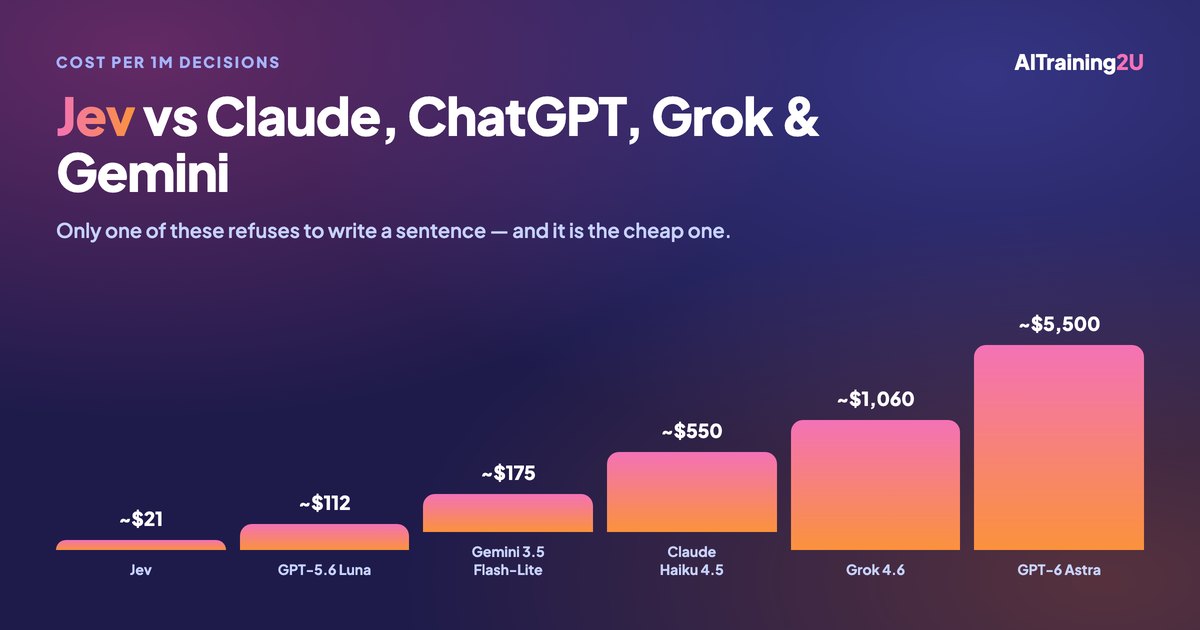
Short answer: Jev is not really competing with Claude, ChatGPT, Grok or Gemini. Those are chat models that write, reason and explain. Jev refuses to write anything and returns a typed decision instead. For a million routine decisions it costs about $21 against roughly $112 on GPT-5.6 Luna, $175 on Gemini 3.5 Flash-Lite, $550 on Claude Haiku 4.5, $1,060 on Grok 4.6 and $5,500 on GPT-6 Astra. But only the chat models can tell you why, and only they can produce text at all.
So the useful question is not “which model is best”. It is which of your jobs are decisions and which are language. Most systems have both.
What a million decisions costs on each
| Model | Input $/MTok | Output $/MTok | 1M decisions* | Explains itself? | Notes |
|---|---|---|---|---|---|
| Jev (TypeSafe) | $0.042 | Free | ~$21 | No | Typed decisions only |
| GPT-5.6 Luna | $0.20 | $1.20 | ~$112 | Yes | OpenAI's cheap tier |
| Gemini 3.5 Flash-Lite | $0.30 | $2.50 | ~$175 | Yes | Google's high-volume tier |
| Gemini 3.8 Flash | $0.75 | $3.75 | ~$413 | Yes | Promotional rate to 31 Dec 2026 |
| Claude Haiku 4.5 | $1.00 | $5.00 | ~$550 | Yes | Anthropic's fast tier |
| Grok 4.6 | $2.00 | $6.00 | ~$1,060 | Yes | xAI flagship; $0.50 cached input |
| Claude Sonnet 5 | $2.00 | $10.00 | ~$1,100 | Yes | Balanced workhorse |
| GPT-5.6 Terra | $2.00 | $12.00 | ~$1,120 | Yes | Mid tier |
| Claude Opus 5 | $5.00 | $25.00 | ~$2,750 | Yes | Frontier reasoning |
| GPT-6 Astra | $10.00 | $50.00 | ~$5,500 | Yes | OpenAI flagship |
*One decision = ~500 input tokens and a short output. Jev's output tokens are free. List prices from Anthropic, OpenAI, xAI and Google, checked 21 September 2026; promotional rates and cached-input discounts are noted where they apply.
Two things stand out. The gap between Jev and a frontier model is enormous, roughly 260x against GPT-6 Astra. But the gap against the cheap tiers is far less dramatic: Luna and Flash-Lite come in at five to eight times Jev's price while still writing text and explaining themselves. At 50,000 decisions a month that difference is a few dollars. It only becomes an argument in the millions.
What each family is actually for
- Claude (Anthropic) — Opus 5 for hard reasoning and long agentic work, Sonnet 5 as the workhorse, Haiku 4.5 when speed and cost matter. Strong on following instructions and structured output, which is why it is the usual baseline when teams test a decision model. See Claude vs ChatGPT.
- ChatGPT / OpenAI — GPT-6 Astra at the top, the GPT-5.6 tiers below it, and Luna as the genuinely cheap option for high-volume work. The widest ecosystem, and the tier most likely to be your real alternative to a decision model on price.
- Grok (xAI) — Grok 4.6 and 4.5 at $2 input and $6 output, with heavy caching discounts and very large context windows. Its differentiator is real-time access to X data rather than price.
- Gemini (Google) — Flash-Lite is the cheap high-volume tier, the Flash models sit above it, and everything is wired into Google Cloud and Workspace. If your data already lives there, that integration usually outweighs a small price gap. See our Gemini training.
- Jev (TypeSafe) — not a chat model at all. One job: return a typed decision with a calibrated probability, in 70 to 500 milliseconds, with an output shape that cannot be malformed.
For a fuller comparison of the chat families themselves, see the frontier model comparison.
Which one for which job
| The job | What to use | Why |
|---|---|---|
| Draft a reply to a customer | A chat model | Jev cannot produce a single word of text |
| Decide which queue that customer goes to | Jev, or a cheap chat tier | A label is the whole answer |
| Summarise a 40-page report | A chat model with a long context | Jev's window is 32k and it does not write |
| Decide whether the summary is on policy | Jev | A yes/no with a probability, thousands of times a day |
| Explain a decision to a regulator | A chat model, or a human | Jev returns no rationale at all |
| Gate a risky tool call inside an agent | Jev | Needs milliseconds, and the answer is binary |
| Work out why a campaign underperformed | A frontier model | Open-ended reasoning across messy inputs |
| Score 50,000 survey responses | Jev or a cheap chat tier | Volume makes the price difference real |
On accuracy, nobody has the clean answer yet
Published third-party tests since launch are small and mixed. On synthetic phishing emails, one broad Jev question scored 62.6% against Claude Haiku 4.5's 81.3%; the same judgement split into five narrow questions put Jev at 95.0% against Haiku's 93.2%. On a 50-case event-screening set, Jev scored 96% against Gemini 3.5 Flash-Lite's 86%. On spam, Jev's 98.33% was level with a plain TF-IDF baseline at 98.39%. Sample sizes are small, several datasets were synthetic, and TypeSafe has published no calibration curves.
The honest summary: on narrow, well-framed questions a decision model is competitive with a cheap chat model and much faster. On one broad question it is worse. Nothing here justifies replacing a working system without testing on your own labelled data. Our detailed comparison includes the fine-tuned-classifier and plain-rules baselines too, which matter more than most vendor benchmarks admit.
The practical setup
A stack that uses each model where it is strongest
- 1Rules firstWhatever can be decided by a keyword, a domain match or an amount threshold should never reach a model. Free, instant, auditable.
- 2A decision model for the repeated judgementRouting, triage, scoring, guardrails. Ask several narrow questions, not one broad one, and keep the confidence value.
- 3A cheap chat tier for the grey zoneLuna, Flash-Lite or Haiku when the case is uncertain and you want a short explanation in the log.
- 4A frontier model for the genuinely hard workWriting, multi-step reasoning, anything a person will read. This is where the quality difference is worth the price.
- 5A human for anything you must justifyRegulated decisions, dismissals, credit, medical. Models prioritise the queue; people decide.
One caution on availability
Claude, ChatGPT, Grok and Gemini are generally available, with published rate limits and support. Jev is in early access behind a waitlist, its architecture is undisclosed, it offers no fine-tuning, and TypeSafe says openly it cannot prove the price is unsubsidised. That is a fine basis for a pilot and a weak basis for a dependency. Build the decision layer so the model behind it can be swapped, and you keep the option either way.
Three days building production AI systems: routing, evaluation, guardrails and cost control across models, not just prompts.
Next public class: 11–13 November 2026 at Worq KL Eco City · seats available
HRD Corp claimable. AITraining2U is an HRD Corp registered training provider. Our public and in-house courses are claimable under the HRD Corp Claimable Courses (SBL-KHAS) scheme, and we prepare the grant paperwork with you. See HRDC-claimable AI training: courses, costs and how to claim.