Short answer: a decision model like Jev earns its place wherever your software makes the same small judgement thousands of times: routing tickets, triaging email, scoring leads, gating what an AI agent is about to do, and checking the output of a bigger model. It cannot write, summarise or explain. It returns a label, a score or a probability in well under a second, at $0.042 per million input tokens.
The test for whether a job belongs here is simple. Write down the answer you want. If it fits in a dropdown, a 0 to 5 score, or a yes/no with a probability, a decision model can probably do it. If the answer is a paragraph, it cannot.
Twelve jobs worth moving off a chat model
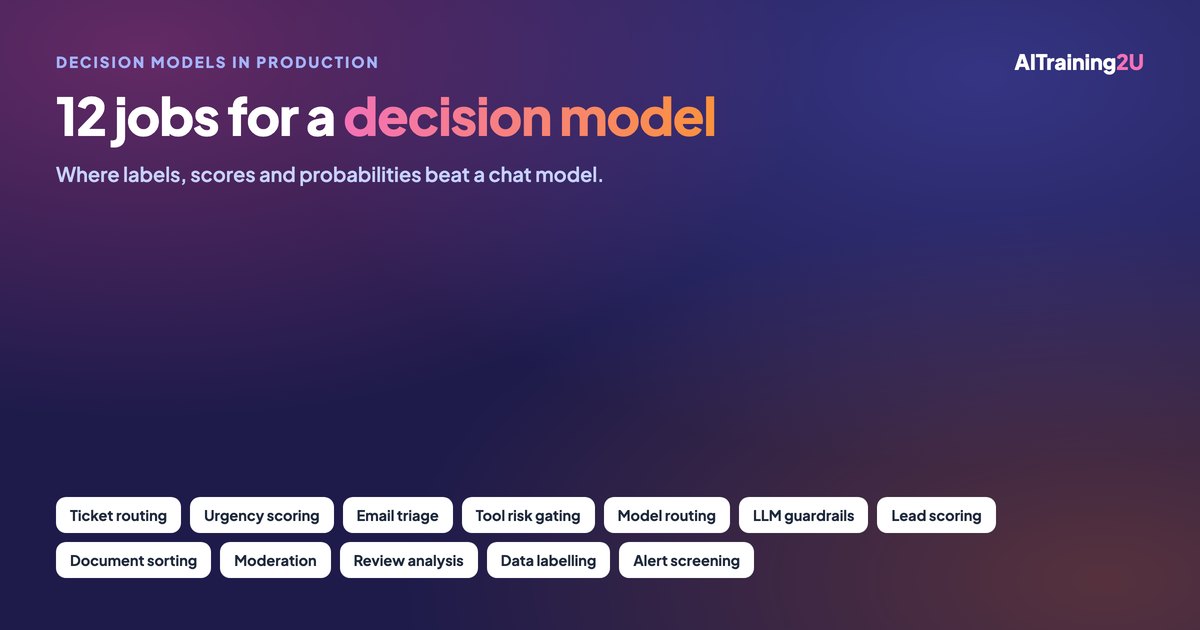
| Job | What you send as state | The question shape | Why it is a good fit |
|---|---|---|---|
| 1. Support ticket routing | The ticket text and customer record | Choice: billing / technical / sales / spam | Replaces a rules file nobody maintains |
| 2. Urgency and frustration scoring | The message thread | Score: 0 to 2 | Decides what jumps the queue |
| 3. Email and spam triage | Subject, sender, body | Noul: is this phishing? | Third-party tests do well here when the question is split up |
| 4. Tool risk gating in an agent | The proposed tool call and arguments | Noul: is this destructive? | Stops an agent deleting data before it acts |
| 5. Model routing | The user request | Choice: cheap model / frontier model / human | Cuts spend without a hand-written rules table |
| 6. LLM output guardrails | The draft the big model produced | Noul: on policy? on brand? | A second opinion for a fraction of a cent |
| 7. Lead qualification | The enquiry email or form | Score plus a choice of segment | Sales sees ranked leads, not a queue |
| 8. Invoice and document sorting | Extracted text from the file | Choice: invoice / receipt / PO / statement | Pairs with the extraction you already run |
| 9. Content moderation | The user submission | Noul per policy line | One narrow question per rule beats one broad one |
| 10. Review and survey analysis | Each free-text response | Score for sentiment, choice for theme | Cheap enough to run on the whole table |
| 11. Data labelling at volume | The raw record | Choice from your taxonomy | Pre-labels a dataset; humans check the low-confidence rows |
| 12. Alert and anomaly screening | The alert payload and recent context | Noul: does a human need to see this? | Kills alert fatigue when calibration holds |
Question shapes use Jev's three primitives: noul (true/false with probability), choice (one of a list) and score (ordered levels).
The pattern that makes any of these work
Every serious write-up of Jev, including the sceptical ones, lands on the same finding: one broad question does poorly, several narrow questions do well. In one third-party phishing test a single question scored 62.6%, while five smaller questions combined reached 95.0%. So design the questions, not the prompt.
Turning a fuzzy judgement into decision-model questions
- 1Write the decision your code must makeNot “analyse this email” but “should this go to the fraud queue, yes or no?”. If you cannot name the branch, you are not ready to automate it.
- 2Break it into signals a person would checkFor phishing: does the sender domain match the brand? Is there a link that does not match its text? Is it demanding urgency? Each becomes its own narrow question.
- 3Ask them in one callSeveral questions about the same state cost little more than one, and each is easier for the model than the whole judgement.
- 4Decide how to combine themA simple weighted rule over the probabilities is usually enough, and it is auditable in a way the model is not.
- 5Set thresholds from your own dataLabel a few hundred real cases. Find the confidence level above which the model is right often enough to act without a human. That number is your automation line.
- 6Send the rest to a person, and log everythingThe cases below the line are your training data for the next iteration and your evidence when someone asks why.
Where it fits in an agent loop
The most interesting use is not classification at all: it is control flow inside AI agents. An agent that calls a frontier model at every decision point is slow and expensive. LangChain’s own write-up frames Jev as the fast layer in the loop: routing to the right model, gating risky tool calls before they run, and deciding whether a result is good enough to stop. The reasoning model still does the thinking; the decision model decides when it needs to. If you are building agents, see our agent training guide and the AI engineering toolkit.
The same idea works in no-code automation. In an n8n workflow, an HTTP Request node calling a decision endpoint gives you a Switch node that understands meaning rather than keywords: route by what a message means, and only pay for the expensive model on the branch that needs writing.
Four jobs to keep away from it
- Anything you must explain. Credit decisions, disciplinary matters, medical or legal triage. There is no rationale to show, so the audit trail stops at a number. Use it to prioritise a human, not to decide.
- Anything that produces text. Replies, summaries, translations, code. Wrong tool entirely.
- Judgements that need your private context. With no fine-tuning available, everything the model knows about your business must fit in the 32,000-token state you send.
- Low-volume decisions. If you make 200 of them a day, a frontier model costs you a few ringgit a month and gives you an explanation. Cost only becomes an argument at volume.
A sensible first project. Take the highest-volume classification you already run through a chat model. Keep it running. Send the same inputs to the decision model in parallel for a week, log both, and compare on the cases where they disagree. You learn the accuracy and the cost on your own data before anything depends on it.
What it costs to run one of these at volume
At roughly 500 tokens of state per decision, one million decisions is about 500 million input tokens: around $21 at Jev’s list price, with output free. The same million through Claude Haiku 4.5 at $1 per million input tokens and $5 per million output is roughly $550. Both are small next to an engineer’s time, which is why accuracy, explainability and integration effort should decide this, not the bill. We work through that trade-off in Jev vs Haiku vs a fine-tuned classifier.
Three days building production AI systems: routing, evaluation, guardrails and cost control across models, not just prompts.
Next public class: 11–13 November 2026 at Worq KL Eco City · seats available
HRD Corp claimable. AITraining2U is an HRD Corp registered training provider. Our public and in-house courses are claimable under the HRD Corp Claimable Courses (SBL-KHAS) scheme, and we prepare the grant paperwork with you. See HRDC-claimable AI training: courses, costs and how to claim.