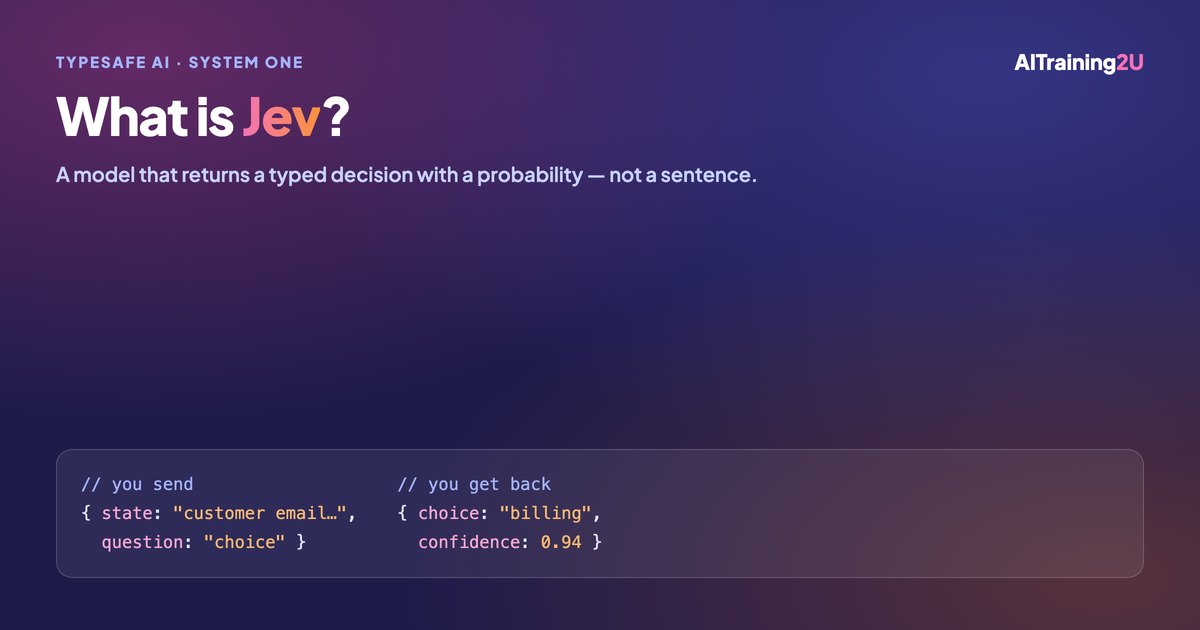
Short answer: Jev is a model from TypeSafe AI that does not write text. You give it some context and a typed question, and it returns a decision your code can act on: a yes/no probability, one option from a list, or a score, each with a confidence value. TypeSafe calls this a System One model. It launched on 15 September 2026 at $0.042 per million input tokens, with output free, and quotes response times of 70 to 500 milliseconds.
Jev is not a Typeface product. Jev comes from TypeSafe AI, a research company whose founder, Diogo Almeida, previously worked at OpenAI. Typeface is a different company altogether: an enterprise marketing AI platform for on-brand campaign production. The names look alike, and searches for “Jev AI by Typeface” are common, but the two are unrelated.
The name comes from Daniel Kahneman’s split between fast, automatic thinking and slow, deliberate thinking. Chat models are System Two: they deliberate, explain and generate. TypeSafe’s argument is that most decisions inside software do not need an essay. They need a label, fast, cheap, and in a shape the next line of code can branch on.
The three question types
Everything Jev does is built from three primitives. You send a state (the email, the ticket, the JSON record) and one or more questions about it.
| Primitive | What you ask | What comes back | Example |
|---|---|---|---|
| Noul | Is this statement true? | A probability from 0 to 1 | “This email is a phishing attempt” → 0.93 |
| Choice | Pick one option from a list | The chosen option, the probability of each option, and a confidence value | Route to billing / technical / sales / spam |
| Score | Rate against ordered levels | A score, probabilities per level, and a confidence value | Customer frustration, 0 to 2 |
Source: TypeSafe AI documentation, September 2026.
You can ask several questions about the same state in one call, which matters for both cost and accuracy. More on that in the comparison.
What is actually new here
Two things, if the claims hold.
- The output cannot be malformed. Because the possible answers are defined in advance, the model cannot return a category you did not list or a broken JSON blob. TypeSafe markets this as “zero hallucinations”, which is a stretch: it means the shape is guaranteed, not that the answer is right. A confidently wrong label is still wrong.
- Calibrated probabilities. TypeSafe says higher confidence genuinely means higher accuracy, trained with something it calls Reinforcement Learning for Calibrated Decisions. If that holds in your data, you get a clean way to auto-handle the confident cases and send the rest to a human. That single property is worth more to most teams than any speed number.
The numbers TypeSafe publishes
| Model version at launch | jev-1.13 |
| Context window | 32,000 tokens |
| Input types | Text only: strings, JSON objects, arrays of text. No images, audio or video |
| Options per choice question | Up to 255 |
| Price | $0.042 per million input tokens; output tokens free |
| Latency | 70ms to 500ms end to end, per TypeSafe |
| Access | Hosted API in early access behind a waitlist; also listed on Cloudflare Workers AI as typesafe/jev |
| Customisation | None at launch. TypeSafe's docs say all accounts share the same weights, with no fine-tuning |
Sources: TypeSafe blog and docs; Cloudflare Workers AI model page. Checked 21 September 2026.
On benchmarks, TypeSafe reports its workflow evaluation running 193.6x faster and 444.6x cheaper than a reference average of GPT-6 Astra and Fable 5.1. Read that with care. TypeSafe’s own team wrote the workflows, the company says some bias could exist, and it openly admits it cannot prove the price is not subsidised. A 444x figure is the peak of a best case, not a planning number.
What independent testing has found so far
Early third-party evaluations are mixed, and more interesting than the marketing. In one widely circulated test on 2,000 synthetic phishing emails, a single Jev question scored 62.6% against Claude Haiku 4.5’s 81.3%. When the same tester split the job into five smaller questions and combined them, Jev reached 95.0% versus Haiku’s 93.2%. On a spam set of 18,514 emails, Jev scored 98.33% against a plain TF-IDF baseline’s 98.39%. And a two-line regex rule beat Jev’s single-question phishing score outright.
The lesson is not “Jev is bad”. It is that how you ask dominates. One broad question underperforms; several narrow questions do well. That is a real engineering skill, and it is the same skill that makes any classifier work.
The honest list of limitations
- No explanation, ever. You get a number, never a reason. For anything you may have to justify to an auditor or a regulator, that is a serious constraint.
- No fine-tuning. At launch every account shares the same weights, so you cannot teach it your edge cases. Your lever is question design.
- Text only, 32k context. No images or audio, and long documents need chunking.
- Early access, no published SLA. It is behind a waitlist, and the architecture is undisclosed.
- Calibration is claimed, not published. TypeSafe has not released reliability curves or expected-calibration-error figures, so test it on your own data before trusting the confidence values.
Should you care?
If you build software that makes many small decisions (routing, triage, screening, guardrails), yes, this class of model is worth a look, whether or not Jev specifically wins. If you use AI to write, summarise or reason, it changes nothing for you: Jev cannot do any of that, and is designed not to. The realistic pattern is both, with a cheap decision model in front of an expensive reasoning model. Our guide to 12 jobs worth giving a decision model covers where that pays off.
Three days building production AI systems: routing, evaluation, guardrails and cost control across models, not just prompts.
Next public class: 11–13 November 2026 at Worq KL Eco City · seats available
HRD Corp claimable. AITraining2U is an HRD Corp registered training provider. Our public and in-house courses are claimable under the HRD Corp Claimable Courses (SBL-KHAS) scheme, and we prepare the grant paperwork with you. See HRDC-claimable AI training: courses, costs and how to claim.