Building Critical Mass of
AI Process Owners
AI transformation stalls when knowledge is concentrated in one team. Sustainable adoption requires a distributed network of process owners who embed AI into the daily rhythm of every department.

Table of Contents
Why Process Owners Matter
Most organisations approach AI adoption with a top-down mandate: leadership announces an AI initiative, the IT department evaluates tools, and a centralised team builds a handful of pilot automations. The problem with this approach is that it creates a dependency bottleneck. When only one team understands how AI works, every department must queue for their attention. Requests pile up, timelines stretch, and the initial enthusiasm fades into frustration. The pilot succeeds, but the organisation never scales beyond it.
Distributed ownership solves this by placing AI-literate process owners inside every department. These are not full-time AI specialists. They are operations managers, marketing leads, finance controllers, and HR executives who understand their own workflows deeply and have been trained to identify where AI can remove friction. They serve as the bridge between the technical possibilities of AI and the operational realities of their teams, and a shared AI vocabulary ensures they can communicate effectively across departments. When a procurement officer understands how to build an automated vendor evaluation workflow, they do not need to file a ticket with IT and wait three months. They build it themselves, iterate based on feedback from their colleagues, and deploy it within weeks.
Research on organisational change consistently shows that adoption becomes self-sustaining when approximately 15-20% of the workforce actively champions a new way of working. Below that threshold, resistors outnumber advocates and the initiative stalls. Above it, social proof takes over and adoption accelerates organically. For a Malaysian mid-sized enterprise with 200 employees, that means training and empowering 30 to 40 AI process owners across departments. This is not about replacing anyone. It is about equipping your existing team through HRDC-claimable training with the skills to make AI part of how they work every day, establishing shared accountability for AI outcomes across the business.
Identifying Your AI Champions
Not every employee is a natural fit for the AI process owner role, and that is perfectly fine. The traits that make someone effective in this role are a specific combination: deep domain expertise in their department's workflows, genuine curiosity about technology and new tools, and enough interpersonal influence to bring their peers along. You are looking for the person who already experiments with new software on their own, who other team members turn to when they are stuck, and who understands the operational pain points that keep their department from performing at its best.
Start by mapping your departments to AI opportunity areas. Finance teams benefit from automated reconciliation, expense classification, and anomaly detection. Marketing departments gain from AI-powered lead scoring, content generation, and campaign analytics. Operations teams can automate procurement tracking, inventory forecasting, and vendor communication. HR departments streamline candidate screening, onboarding workflows, and employee sentiment analysis. Tools like n8n automation training equip these champions with practical skills to build workflows themselves. Each of these areas represents a natural home for an AI process owner who understands the existing workflow and can envision its AI-enhanced future.
Executive Sponsors
C-suite and senior leaders who set the strategic direction, allocate budget, and remove organisational blockers. They do not build automations themselves but ensure the initiative has visible backing and resources.
Department Leads
Mid-level managers who own specific business processes. They receive hands-on AI training, identify automation opportunities in their domain, and serve as the primary trainers for their teams.
Power Users
Individual contributors who build and maintain automations daily. They are the hands-on practitioners who turn ideas into deployed workflows and who provide peer support to colleagues still learning.
This three-tier model ensures that AI adoption has strategic backing at the top, operational ownership in the middle, and practical execution at the ground level. When all three tiers are active, knowledge flows in both directions: leadership understands what is possible because department leads report real results, and power users feel empowered because they have explicit support from above. In Malaysian organisations where hierarchy plays a significant role in decision-making, having visible executive sponsorship is particularly critical for giving department leads the confidence to experiment and iterate without fear of failure.
The Training Cascade Model
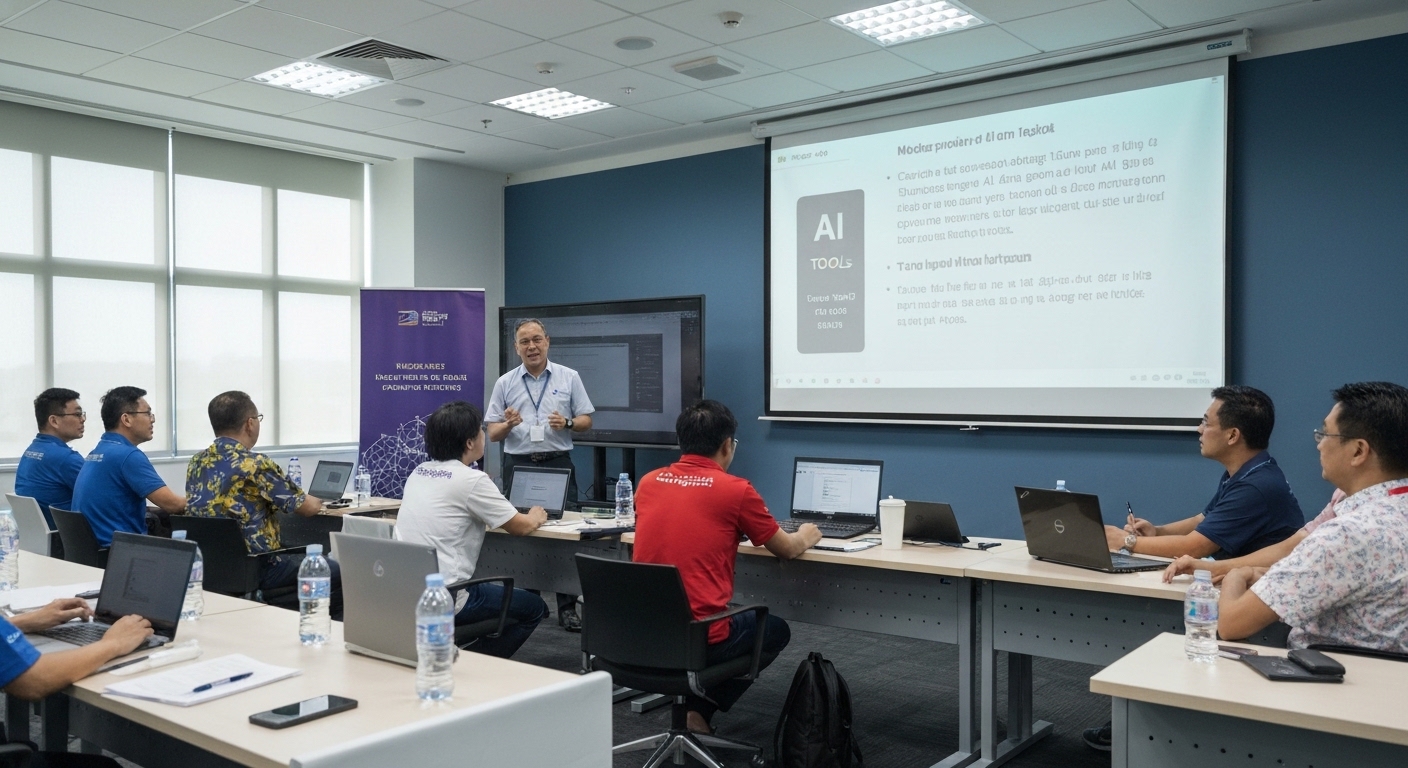
Sending your entire organisation through an external AI training programme simultaneously is neither practical nor cost-effective. The cascade model takes a different approach: train a small cohort of internal champions intensively, then equip them to train their own teams. This train-the-trainer methodology multiplies your training investment exponentially. A cohort of 8 department leads, each responsible for upskilling 5-10 team members, can produce 40-80 AI-literate practitioners within a single quarter.
The most effective cascade programmes are cohort-based, meaning participants move through the training together as a group rather than at their own pace. Cohort-based learning creates peer accountability, where participants commit to completing hands-on projects between sessions and present their progress to the group. This social pressure is productive. It prevents the common pattern where individuals attend a workshop, return to their desks, and never apply what they learned because daily work pressures take over. When your cohort meets fortnightly to share what they have built, deployed, and learned, the knowledge compounds.
Each participant in the cascade should be required to complete at least one live automation project that solves a real problem in their department. This is not a theoretical exercise. The project must be deployed, used by actual colleagues, and measured for impact. Certification serves as an additional motivator. When AITraining2U delivers corporate AI training programmes for Malaysian enterprises, participants who complete their projects and pass the assessment receive formal certification, which they can present during performance reviews and which the organisation can use to track its growing AI capability. Peer accountability groups of 3-4 participants who check in weekly on each other's progress further reinforce follow-through and create lasting internal support networks.
Embedding AI Into Daily Workflows
Training without application is wasted investment. The goal is not to create people who know about AI but people who use AI as a natural part of how they work. The most reliable way to achieve this is to start small and concrete: one automation per department, solving one specific pain point. For a finance team, that might be an automated invoice data extraction workflow using AI agentic automation. For marketing, it could be an AI-powered content brief generator connected to their WhatsApp broadcast system. For HR, an automated candidate screening pipeline that summarises CVs against job requirements.
Once these initial automations are live and delivering value, the next step is building shared automation libraries. When one department creates a workflow that works well, document it and make it available to others. A shared internal repository of proven automations, much like the Supern8n marketplace model, prevents teams from reinventing the wheel and accelerates adoption across the organisation. Establish regular review cadences, either monthly or quarterly, where process owners from different departments present their automations, share metrics on time saved, and identify cross-departmental opportunities.
Celebrate early wins publicly. When a process owner in your Kuala Lumpur operations team reduces a weekly reporting task from four hours to fifteen minutes, make sure leadership and other departments hear about it. These visible successes do more to drive adoption than any top-down mandate. Connect every process improvement to measurable KPIs: hours saved per week, error rates reduced, customer response times improved, or revenue influenced. When AI process owners can demonstrate concrete business impact, it reinforces their role, justifies further investment in training, and motivates colleagues who have not yet started their own AI journey.

Scaling From Pilot to Organisation-Wide
The journey from 3-5 initial champions to organisation-wide critical mass follows a predictable pattern, but it requires deliberate effort at each stage. In the pilot phase, your first cohort of AI process owners focuses on proving the concept within their own departments. They build automations, document results, and develop the internal case studies that will convince the next wave of participants. This phase typically takes 2-3 months and should produce at least 3-5 working automations with measurable impact, establishing clear automation milestones that demonstrate progress to leadership.
The expansion phase is where cross-departmental knowledge sharing becomes critical. Establish regular forums, whether monthly lunch-and-learns, internal showcases, or a dedicated Slack channel, where process owners share what they have built. In many Malaysian organisations we work with, these sessions become the most popular internal events because they combine practical demonstration with genuine peer learning. When a procurement manager shows how they automated vendor comparison across 50 suppliers in under a minute, colleagues from other departments start asking how they can do something similar. This organic demand is far more powerful than any top-down directive.
As adoption grows beyond individual departments, consider establishing a formal AI Center of Excellence. This is not a large new team. It is a lightweight coordination function, often just 1-2 people, that maintains standards, curates the shared automation library, tracks adoption metrics across the organisation, and connects process owners who could benefit from each other's work. Measure adoption rates quarterly: how many departments have active AI process owners, how many automations are in production, what is the total time saved, and what percentage of the workforce has completed at least basic AI training. These metrics tell you whether you are approaching critical mass or whether specific departments need additional support to get started.
Frequently Asked Questions
Research on organisational change suggests you need 15-20% of your workforce to be AI-literate advocates before adoption becomes self-sustaining. For a 200-person company, that means 30-40 trained AI process owners spread across departments. Start with 3-5 champions in your pilot phase and scale from there over 6-12 months.
Effective AI process owners combine three qualities: deep domain expertise in their department's workflows, genuine curiosity about AI tools and automation, and interpersonal influence to bring colleagues along. Technical coding skills are not required. The most impactful process owners are those who understand the pain points of their daily operations and can translate AI capabilities into practical solutions their team will actually adopt.
Motivation works best through a combination of recognition, career development, and visible impact. Publicly celebrate early automation wins, tie AI champion roles to promotion criteria, and ensure process owners see tangible time savings from their efforts. Certification programmes and internal titles such as AI Lead or Automation Champion also help. Most importantly, give them dedicated time during work hours for AI exploration rather than adding it on top of existing responsibilities.
Both, but prioritise business units. The biggest bottleneck in AI adoption is rarely technical capability; it is understanding which processes benefit most from automation and getting buy-in from the people doing the work. Business unit process owners have the domain knowledge and peer relationships to drive adoption at the ground level. IT provides infrastructure, governance, and technical support, but the ownership of AI within daily workflows should sit with the departments that use them.
Most organisations can reach critical mass within 9-18 months using a structured cascade model. The first 3 months focus on training an initial cohort of 3-5 executive sponsors and department leads. Months 4-9 involve those leads training power users within their teams. By months 10-18, peer-to-peer knowledge sharing accelerates adoption organically. The timeline varies based on company size, existing digital maturity, and leadership commitment.
Ready to Build Your AI Champion Network?
Start with a trained cohort of AI process owners and scale to organisation-wide adoption. AITraining2U delivers hands-on corporate AI training programmes designed to create self-sustaining AI capability inside your business. HRDC claimable.