AI Vocabulary &
Understanding Alignment
Misaligned understanding of AI creates silos, miscommunication, and failed projects. When your marketing team, IT department, and leadership each have a different definition of "AI," transformation stalls before it starts.

Table of Contents
The Language Problem
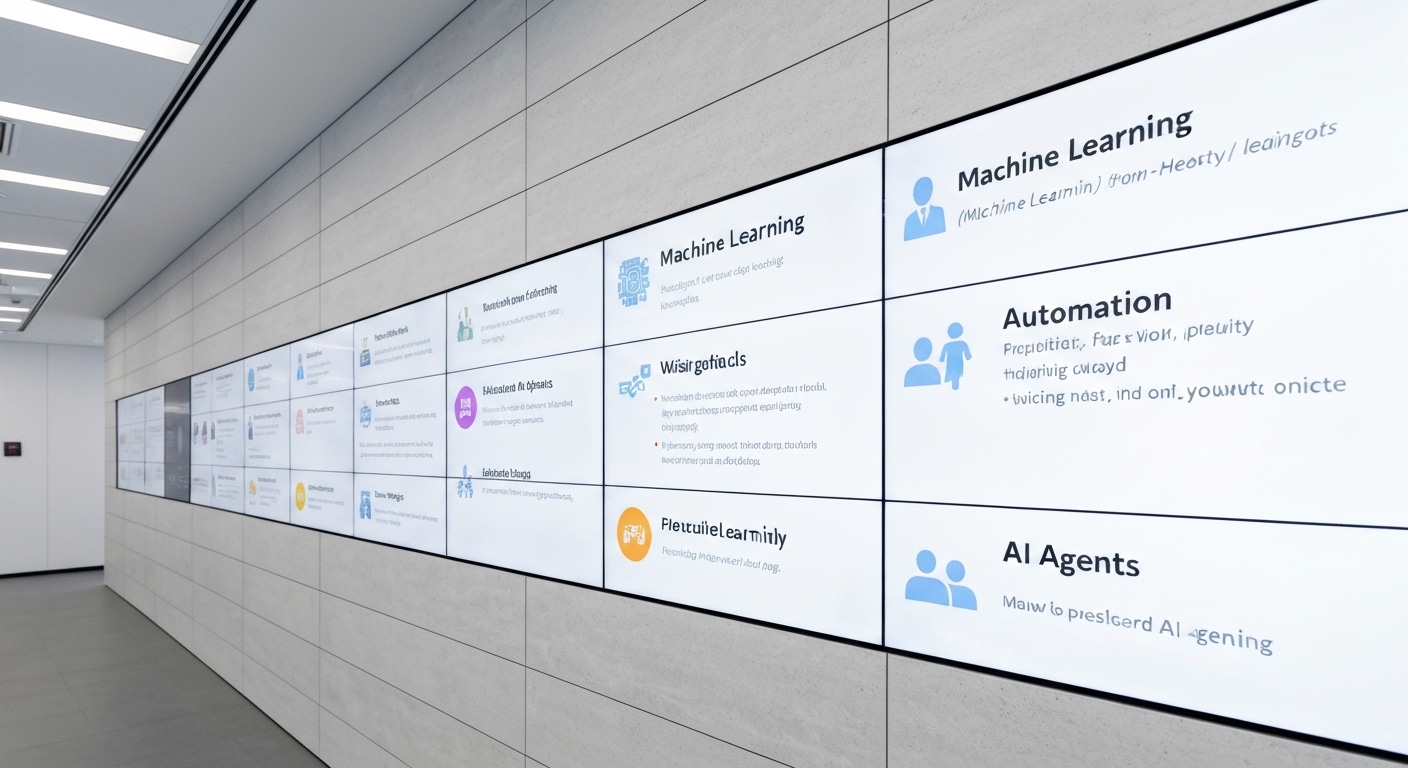
Walk into any Malaysian enterprise today and ask five different department heads what "AI" means, and you will receive five different answers. Marketing interprets AI as chatbots and content generators. IT hears machine learning models and cloud infrastructure. Finance thinks of predictive analytics and fraud detection algorithms. Operations envisions robotic process automation. The CEO saw a demo at a conference and believes AI will replace half the workforce within a year. None of these interpretations are wrong, but none of them are complete, and critically, none of them are aligned.
This vocabulary gap is not a minor inconvenience. It is the root cause of some of the most expensive failures in AI adoption. When a leadership team approves a budget for an "AI project" without a shared understanding of what AI means in their specific context, the resulting initiative is built on ambiguity. The IT team scopes a machine learning model. Marketing expected a chatbot. Finance wanted a dashboard. Six months and hundreds of thousands of ringgit later, no one is satisfied because the project delivered exactly what was asked for by one department while failing to meet the unspoken expectations of everyone else.
The vocabulary gaps between departments typically follow predictable patterns. Technical teams overestimate what non-technical colleagues understand about model architectures and data pipelines. Business teams overestimate what AI can do autonomously without human oversight or structured data. Leadership underestimates the time and resources required because vendor marketing presents AI as plug-and-play. Closing these gaps does not require turning every employee into a data scientist. It requires establishing a shared language, supported by governance frameworks, that enables meaningful cross-functional conversations about AI capabilities, limitations, and realistic outcomes.
From Concepts to Capabilities
Understanding AI vocabulary is only valuable if it connects to a realistic picture of what AI can and cannot do today. One of the most damaging patterns in Malaysian organisations is the gap between AI hype and AI reality. Teams read headlines about artificial general intelligence and assume that current tools can think, reason, and operate independently like a human employee. The truth is more nuanced and, in many ways, more useful. Today's AI excels at pattern recognition, language processing, data extraction, content generation, and decision support. It does not understand context the way humans do, it can hallucinate confidently incorrect information, and it requires careful guardrails to operate reliably in business environments.
Realistic capability mapping is a structured exercise where teams evaluate their existing business processes and identify where AI tools can deliver genuine value versus where traditional automation or human judgment remains superior. Not every process benefits from AI. A simple rule-based workflow that moves data between two systems does not need a large language model. But a process that involves reading unstructured customer emails, classifying intent, extracting key data points, and routing to the appropriate team is precisely where AI delivers transformative results. Teaching teams to make this distinction prevents both under-investment in high-value AI opportunities and over-investment in AI solutions for problems that simpler tools solve better.
Avoiding the hype cycle trap requires a culture of honest evaluation. When a vendor demonstrates an AI product, your team should be equipped to ask the right questions: What data does this require? What happens when the input is messy or incomplete? What is the failure mode? How does it handle edge cases? What does ongoing maintenance look like? Organisations that build this critical evaluation capability across departments make significantly better purchasing and implementation decisions. They invest in AI where it matters and avoid the costly disappointment of deploying sophisticated technology against problems it was never designed to solve.
Structured Learning Paths
Effective AI vocabulary alignment requires structured, role-specific learning paths rather than a one-size-fits-all approach. Executives need strategic-level understanding: what AI means for competitive positioning, how to evaluate AI investments, what realistic timelines look like, and how to set measurable transformation goals. They do not need to understand neural network architectures, but they must be able to distinguish a genuine AI capability from vendor exaggeration. Middle managers need operational-level knowledge: how to identify automation opportunities within their teams, how to scope AI projects, how to manage AI-augmented workflows, and how to measure outcomes. Practitioners and frontline staff need practical, hands-on exposure: using AI tools in their daily work, understanding prompt engineering basics, knowing when to trust AI output and when to verify it manually.
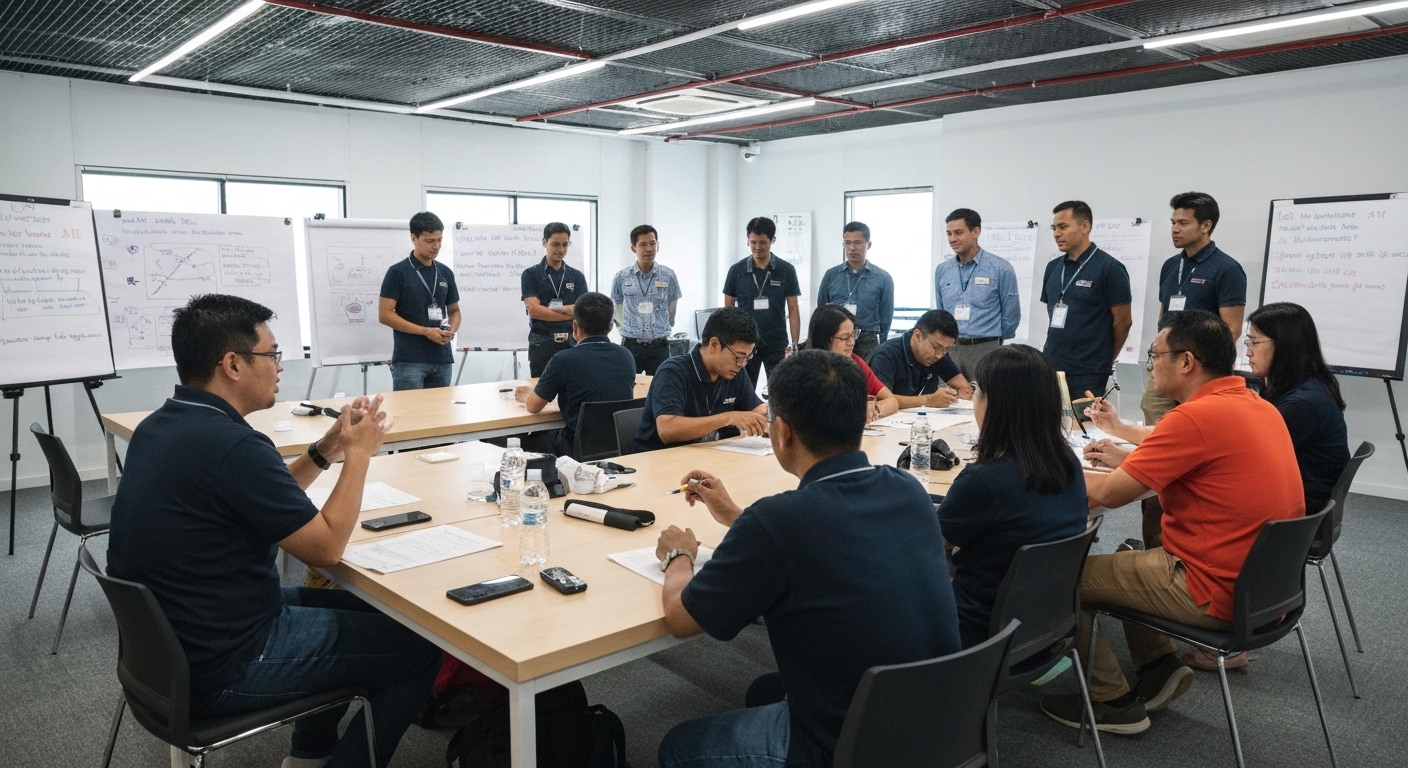
The most effective format for building organisational AI literacy is a combination of structured workshops and ongoing micro-learning. AITraining2U's HRDC-claimable courses in Malaysia begin with intensive two-day workshops where teams work through real business scenarios relevant to their industry, including hands-on AI vibe coding workshops for practitioner-track participants. These are followed by a lunch-and-learn series, typically biweekly sessions of 45 to 60 minutes, where teams explore a single AI topic in depth. Topics rotate through practical demonstrations, case studies from Malaysian businesses, hands-on tool exploration, and open Q&A sessions where teams can bring real challenges they are facing. Organisations can also supplement structured training with free AI webinars to maintain momentum between workshop sessions.
Creating AI reference materials is another critical investment. Beyond the internal glossary, organisations benefit from department-specific AI playbooks that document approved use cases, recommended tools, data handling guidelines, and escalation procedures. These materials serve as the ongoing reference point that maintains alignment long after the initial training sessions end. The learning cadence should be continuous, not episodic. AI technology evolves rapidly, and an organisation that trained its staff once in 2025 and never revisited the curriculum will find its vocabulary and understanding outdated within months.
Executive Track
- AI strategy and competitive positioning
- Investment evaluation frameworks
- Risk assessment and governance
- Vendor due diligence for AI solutions
Practitioner Track
- Hands-on AI tool proficiency
- Prompt engineering fundamentals
- Workflow automation with n8n
- AI output verification and quality control
Measuring Alignment
What gets measured gets managed, and AI vocabulary alignment is no exception. Without concrete metrics, it is impossible to know whether your investment in AI literacy is producing results or simply generating a warm feeling of progress. The most effective organisations treat AI understanding alignment as a measurable business initiative with clear KPIs, regular assessments, and direct linkage to project outcomes. AI literacy assessments, administered quarterly, provide the clearest signal. These are not academic exams; they are practical evaluations that test whether employees can correctly identify which AI approach suits a given business problem, explain AI concepts to a non-technical colleague, and recognise the limitations of AI-generated outputs.
Cross-team project success rates are the ultimate lagging indicator of alignment quality. Track the percentage of AI-related projects that are delivered on scope, on time, and with stakeholder satisfaction. When vocabulary alignment improves, you will see a measurable reduction in scope changes driven by misunderstanding, fewer project pivots caused by unrealistic expectations, and faster time-to-value because teams spend less time debating what "AI-powered" actually means in the context of their specific initiative. Reduction in miscommunication incidents is another trackable metric. Some organisations log instances where AI project misunderstandings cause delays, rework, or stakeholder friction. Monitoring this over time reveals whether your alignment efforts are closing the gaps that matter.
Stakeholder satisfaction surveys, conducted after each AI project milestone, provide qualitative insight that complements the quantitative metrics. Ask stakeholders whether they felt adequately informed, whether the project outcome matched their expectations, and whether cross-departmental communication was effective. Finally, benchmarking against industry peers gives context to your progress. Malaysian organisations can leverage industry reports and HRD Corp training benchmarks to understand how their AI literacy compares to competitors. AITraining2U provides post-training assessment reports that help organisations track their progress over time and identify areas where additional focus is needed.
Ready to Align Your Team's AI Understanding?
AITraining2U helps Malaysian organisations build shared AI vocabulary and understanding across every department. From executive briefings to hands-on practitioner workshops, our programs create the alignment your AI transformation needs. HRDC claimable for corporate teams.
Frequently Asked Questions
Common questions about AI vocabulary and understanding alignment.