
Every finance team has a person who is quietly the bottleneck — keying invoices, matching bank lines, chasing overdue payments. n8n is where you hand that repetitive work to an AI agent. It is an open-source, visual automation platform with a native AI Agent node and native connectors for Xero, QuickBooks, Stripe, Wise and hundreds more — so a finance person, not a software engineer, can build agents that read a document, reason about it, and act. This guide is part of our tool-by-tool series on agentic finance automation (see also Copilot 365, Lark, Gemini and Claude).
Why n8n fits a finance team
Three reasons finance teams reach for n8n specifically. First, it connects to the tools you already run — native nodes for Xero, QuickBooks Online, Stripe, PayPal, Wise and Chargebee, plus an HTTP node that talks to any bank or ERP API. Second, the AI Agent node (built on LangChain) lets the workflow reason and call tools, not just move data from A to B. Third — and this is the one that matters most to a Malaysian controller — you can self-host n8n so invoices, credentials and customer data never leave your environment, which directly helps with PDPA and confidentiality obligations. Add SSO, role-based access, audit logs and human-in-the-loop approval gates, and you have controlled, auditable automation rather than a black box.
Six agentic finance workflows that earn their keep
None of these are science projects. They are the unglamorous, high-volume tasks where an agent removes real hours — each one keeping a human approving anything that touches money.
| Finance use case | How the AI agent works | The payoff |
|---|---|---|
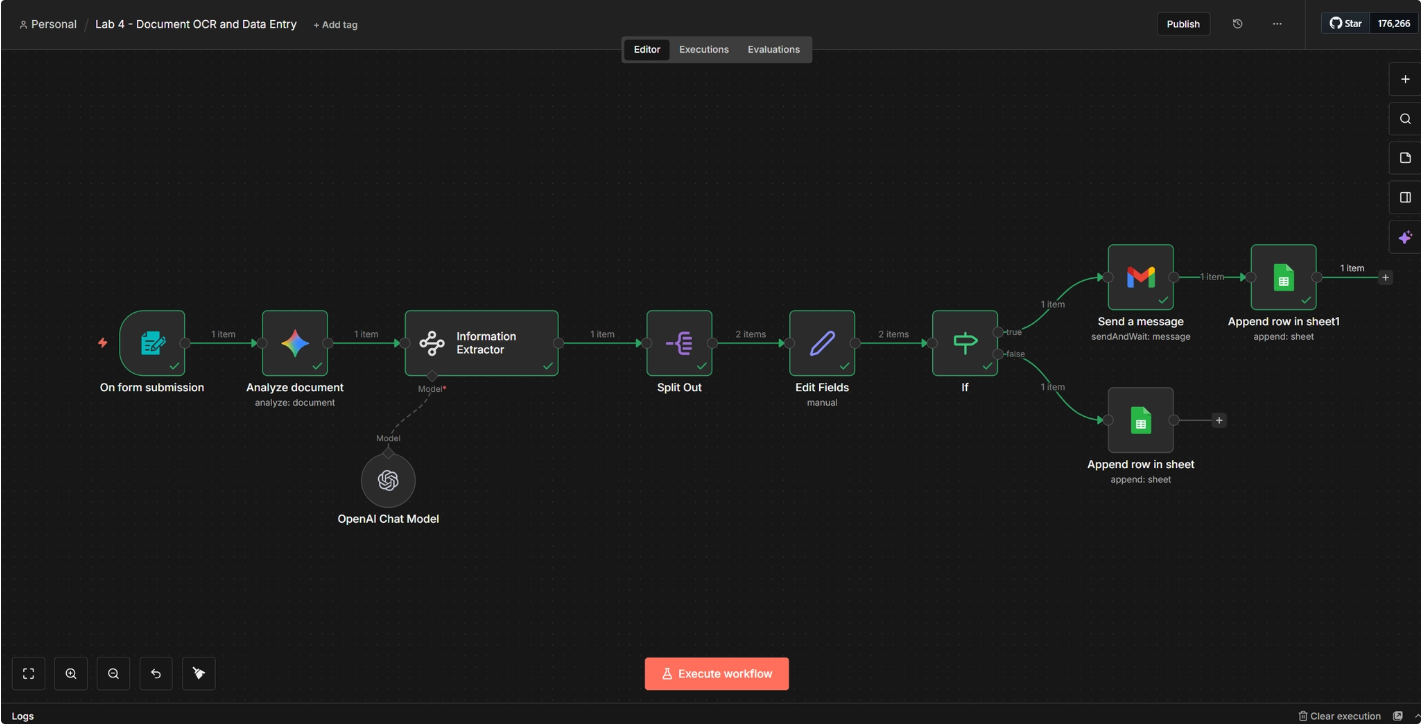
| 1. Invoice ingestion + 3-way match (AP) | A new invoice email triggers OCR extraction (Mindee / Google Document AI); the AI Agent normalises the vendor, converts FX, pulls the matching PO and goods-receipt, and reconciles quantities and prices. Exceptions route to a human; clean invoices post to Xero/QuickBooks with an audit bundle. | Near-touchless AP; blocks duplicate and over-payments; minutes instead of ~10–15 min of keying per invoice. |
| 2. Bank reconciliation / cash application | A daily scheduled pull of bank transactions; the agent matches statement lines to open invoices and assigns a confidence score. High-confidence matches clear automatically; low-confidence and FX-variance items route to review with a suggested journal entry. | Cash applied daily, faster close, real-time cash visibility. See our reconciliation guide. |
| 3. AR collections / dunning | A scheduled sweep of open receivables; the agent buckets by ageing (0–30 / 31–60 / 61–90+) and drafts tone-graduated reminders (polite → firm), sending by email or WhatsApp and escalating to an owner at set thresholds. | Consistent follow-up with no manual chasing; lower DSO; a complete contact history in the ledger. |
| 4. Expense & approval routing | A submitted receipt triggers OCR and GL categorisation; in-policy items auto-approve, over-threshold or anomalous ones route to a manager via Slack/Teams with a Wait-node approval, then post to the accounting system. | Faster reimbursements, enforced policy, managers only touch exceptions. |
| 5. Month-end management pack | On period close, the agent pulls the trial balance and P&L, computes variances against budget, writes plain-language commentary, renders a formatted PDF/deck and distributes it. | Draft management reporting in minutes; analysts review instead of assemble. Pairs with financial reporting. |
| 6. Anomaly & duplicate-payment flagging | On each new payment or a scheduled sweep, the agent scores transactions against patterns — duplicate invoice numbers, changed bank details, unusual amounts or geographies — then freezes suspect items and opens an investigation task. | Earlier fraud and leakage detection with an auditable evidence trail. |
What is actually real today — and the honest limits
The building blocks are shipping: the AI Agent node with tool-calling, 79 apps in n8n’s finance category, and human-in-the-loop gating so an agent cannot post a journal or release a payment until a person approves. But be clear-eyed. OCR is not native and not 100% accurate — messy or handwritten invoices need review, and you depend on whichever document-AI you plug in. LLMs can hallucinate, so human approval on financial postings is essential, not optional. And a production finance workflow needs real error-handling, retries and monitoring — templates are a starting point, not a turnkey system. The teams that win treat n8n as a controlled tool with guardrails, not a magic button.
The Malaysian angle: self-hosting and HRD Corp
For a Malaysian SME, the self-hosting story is the differentiator: run n8n on your own server (or a local VM) and sensitive ledgers never touch a third party, with the LLM calls scoped to only what is needed. On funding, the skills to build this are HRDC-claimable through SBL-KHAS for registered employers — our HRDC AI training page covers the claim. If you want the broader picture first, read what is agentic AI and AI for accountants in Malaysia.
Learn to build finance agents with n8n
- Build a live invoice-to-ledger agent on your own data
- Bank reconciliation and AR collections flows, end to end
- Human-in-the-loop approval gates and self-hosting for PDPA
All classes are HRDC-claimable for eligible employers — delivered on your own finance processes and data.
Where to start
Pick one high-volume, rules-based process — usually AP invoice processing or bank reconciliation — and build that single agent well, with a human approving the postings. Prove the hours saved, then expand. n8n rewards starting small and compounding.
If you want to see this pattern running rather than read about it, SuperAgentK is a Malaysian-built agentic workspace — a team of AI agents in your own sandboxed environment that arrive already knowing Malaysian statutory rules (EPF, SOCSO, payroll deadlines) and plug into the systems you already run. There is a live demo at demo.superagentk.com.
Disclosure: SuperAgentK is co-founded by a member of the AITraining2U team.