AITraining2U × Claude
01 / 24
◄ ► or Space to navigate · G for slide menu · F for presentation mode · Esc to exit
AITraining2U
Webinar · For Business Owners, Founders & Finance Leads

Save Money
with Claude

Most businesses don't have a revenue problem — they have a leak problem. Four worked examples that find the money you're already losing: subscriptions, supplier prices, outsourced spend and manual hours.

Examples
4 End-to-End
Format
Live · Hands-on
Take-home
Copy-ready Prompts
Practical. Proven. Purposeful. — AITraining2U PLT
Your Trainers

Led by practitioners,
not theorists

Chan Wei Khjan

Chan Wei Khjan

Audit Partner, YYC · MIA Board

Chartered Accountant (ACCA · C.A.(M) · FCA Singapore) and MIA board member. Featured in Business Insider for pioneering AI inside the accounting profession.

Marcus Chia

Marcus Chia

AI Product Manager & Harness Engineering Expert

Builds and ships AI workflows in the wild — Claude projects, MCP servers, multi-agent pipelines and data dashboards. Turns messy business problems into working AI solutions.

Warren Leow

Warren Leow

Founder, AITraining2U PLT

Drives AITraining2U's mission to equip 100,000 Malaysians with practical AI skills — hands-on with AI agents, automation and applied analytics for enterprise teams.

Today you'll build alongside us — every example paired with something you can run on a real invoice, quote or statement the moment you're back at your desk.

Our Clients

Trusted by leading Malaysian organisations

BFM
CCM
CTOS
Commerce.Asia
Evolution Commerce
Gamuda
Gentari
Grab
IGB
Inside Scoop
Jaya Grocer
KLK
MoneyMatch
Mr DIY
Mydin
myNEWS
Pharmaniaga
PMG Healthcare
Ryt Bank
Shopee
Tealive
U Mobile
YYC
ZUS Coffee

Banking, telco, retail, healthcare, energy & government-linked companies — teams across Malaysia upskill with AITraining2U.
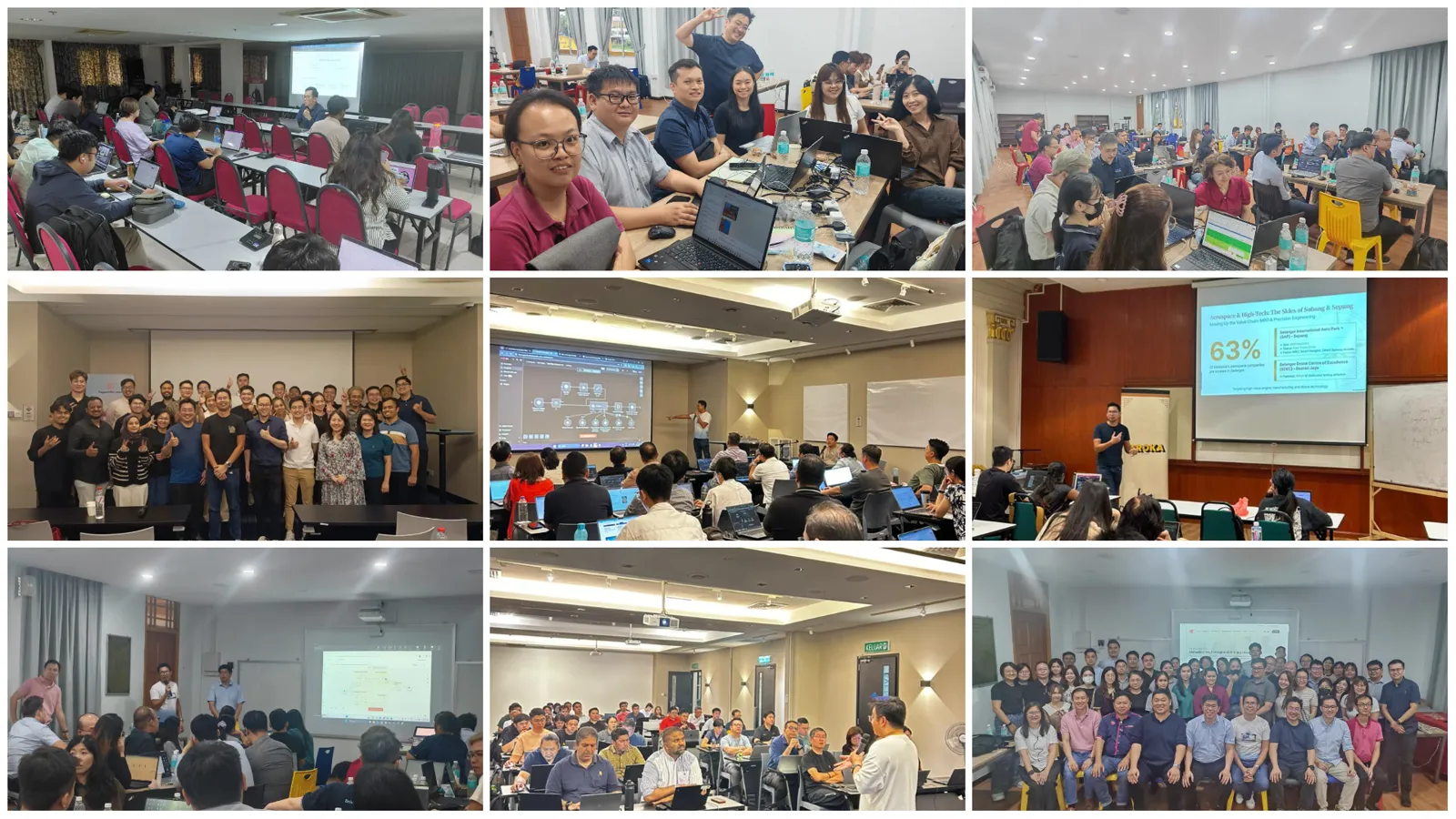
Proven Track Record 1,500+ professionals trained — and counting
Collage of AITraining2U training sessions across Malaysian enterprises and public workshops
HRDC-claimable Enterprise & public workshops Practical, hands-on, results-first
Foundations First

Margin leaks in four places

None of them look like a crisis on their own. Together they are the cheapest money you will make this year — because you have already earned it.

The Real Bottleneck

Most owners aren't short
on ways to make money.

They're short on visibility over what leaves — the renewals nobody approved, the supplier who quietly raised 18%, the invoice you pay every month for work your team could now do in an afternoon.

A real finance function has a cost controller, a procurement lead and an ops analyst asking those questions every month. Run Claude as all three, and the review that never gets done takes a prompt.

WHAT A CFO WOULD DO IN WEEK ONE
See every ringgit going out
Twelve months, categorised — not a feeling, a table
Question every price you pay
List price is an opening offer, not a fact
Separate expertise from volume
Pay specialists for judgment — not for typing
Put a price on manual hours
Admin time is payroll — count it before you defend it
Three Moves First

Three moves that pay for
everything else

1
Pay for Claude, ChatGPT & Gemini
The cheapest line on your P&L is the one that finds the others. Free tiers can't read your files, hold your context, or run on a schedule.
2
Juniorise the team
Hire for judgment, not for years served. A junior with a good brief and the right tool now drafts what used to need a specialist — with a senior reviewing, not typing.
3
Set a goal to cut cost by X%
A number, an owner and a date. “Save where we can” saves nothing. “10% of controllable cost by March, owned by name” does.

None of these is a prompt. They're the conditions that decide whether the next four examples actually land money in your account — or just make a nice slide.

Tip 01Pay for the Tools

The cheapest hire you'll make this year

The free tier can't do this work
Smaller context, older models, tight file limits, no connectors and no scheduling. Every prompt in this deck assumes a paid seat.
Why all three, not just one
They're not interchangeable. Run a price benchmark past two engines and you'll catch the one that was confidently wrong.
Seats go to whoever does the volume
The exec doing the reports needs it more than the boss who reads them. A seat parked with a director earns nothing.
Then audit it like everything else
It's a subscription too. Seats paid vs seats used, reviewed every month — same rule as Example 01.
What it costs vs what it found — Kopi Kita
LinePer monthPer year
5 seats on the primary engineRM 475RM 5,700
2 seats on the other two, for cross-checksRM 190RM 2,280
Total tool spendRM 665RM 7,980
Cash found by the four examplesRM 84,040
PaybackAbout 5 weeks — then roughly 10× for the rest of the year

Seat prices are indicative at roughly RM95 per seat per month for an entry paid tier — check current rates, and ask about annual and team pricing before you buy.

Tip 02Juniorise the Team

Hire for judgment. Let the tool supply the experience.

What changes
A junior with a clear brief and a paid seat produces a credible first draft of work that used to need a specialist.
What doesn't
Someone still has to know when the draft is wrong. Review, judgment, client trust and sign-off stay senior.
Budget the training with the seat
A junior handed a tool and no training is just a slower junior. A week of it changes the whole return.
The trap
Juniorise the doing. Never juniorise the checking — that's how a confident wrong answer reaches a customer.
Team shape, before and after
The workUsed to needNowSenior still does
Monthly ops reportOutsourced analyst, 8 daysJunior finance exec + AI, 2 hrsReads it, signs it
Social content, 24 postsAgency retainerMarketing exec + house briefApproves the month
Supplier & market research2 days of a managerJunior + AI, 2 hrsDecides what to do with it
Board packConsultant formattingJunior drafts from our numbersWrites the commentary

This is about the shape of your next hire and where senior time goes — not a case for cutting the people who already know why the numbers matter.

Tip 03Set the Target

“Save where we can” saves nothing

Set it on cost you can actually move
Take payroll and rent out first. What's left is the base you're allowed to attack this year.
Pick a number that stings slightly
5% is noise and nobody changes behaviour. 20% breaks something. 8–10% is a year of honest work.
One owner per lever
A name against each of the four levers, with a date. Not a committee, not “finance”.
One page, once a month
Target, found, banked, still open. If it hasn't shown up in the P&L, it isn't banked.
The target, worked — Kopi Kita, 12 months
LineRM
Total outgoings3,492,549
less payroll & bonus(1,484,387)
less outlet rent(1,152,000)
Controllable base856,162
The goal — 10%85,616
Found across the four examples84,040
Still to find1,576

Plus 26 hours a week returned — that's capacity, not cash. Count it on a separate line or you'll report a saving you can't find in the bank.

The Map

Four ways to save money
with Claude

1
Find the Leaks
Twelve months of spend, categorised — duplicate tools, unused seats and the renewals that quietly went up.
2
Pay Less for the Same Thing
Quotes normalised to like-for-like, benchmarked against the live market, with the negotiation email drafted.
3
Insource the Volume
Keep specialists for specialist work. Take back the first drafts, the resizes and the monthly reports.
4
Automate the Hours
Price the manual admin in ringgit, automate the rule-based part, and give the hours back to the team.

Every example ships with a set of copy-ready prompts — tap Copy, paste into Claude, edit the bracketed bits, run.

Example 01Find the Leaks

You can't cut what you can't see

Twelve-month spend x-ray
Every line categorised, ranked by ringgit, shown as a % of total.
Duplicate & zombie tools
Two subscriptions doing one job — and the seats nobody has logged into.
Silent price creep
The renewals that went up 10-20% and never crossed your desk.
Runs on a schedule
Cowork re-reads the statement monthly and emails what changed — set once with Schedule.
claude.ai · Spend Audit
SOURCES
Bank export
Card statement
Tool list
OUTPUT
Leak table
Cancel list
Categorised Flagged
Where is our money actually going?
Read 12 months, 214 line items. Found: 3 duplicate tools, 6 unused seats, 1 fee tier up 18%. ≈RM23k/year recoverable — table & cancel list built →
Example 01 · PromptsCopy · Paste · Run Exercise files (.zip)

Spend audit prompt set

1 · Spend x-ray
Act as our cost controller. I'm
attaching [12 months of bank / card
transactions, or our P&L export].

1. Categorise every line: software &
   subscriptions, suppliers, outsourced
   services, marketing, payroll, other.
2. Rank categories by annual spend and
   show each as a % of total.
3. Flag anything questionable — duplicate
   charges, two tools doing one job,
   anything that rose more than 10% vs
   last year, and any charge we can't
   identify.

Output: a summary table by category, plus
a "questionable spend" table with amount
per year and why it's flagged.

Ask me before assuming what an unclear
line item is.
2 · Trim the stack
Now take the software & subscriptions
list and review our whole stack.

For each tool: what it does, cost per
month and per year, seats paid vs seats
actually used [I'll paste usage], which
other tool in our stack overlaps with it,
and the cheaper route — annual plan,
lower tier, free tier or a competitor.

Then give me three lists:
- CANCEL NOW
- DOWNGRADE
- CONSOLIDATE INTO [tool]

Each line: amount saved per year, and
what we actually lose by doing it.
Sort by savings, total it at the bottom.
3 · Automate the watch
Automate this. Using Cowork,
Schedule it for the 1st of every
month:

1. Read our latest statement export and
   compare it to last month.
2. Flag NEW charges, any amount that went
   up, and every renewal falling due in
   the next 45 days.
3. Re-check the cancel list — did those
   charges actually stop?

Email me a one-page spend digest via
Gmail, with a "cancel before this
date" section at the top. Draft it —
don't send.

Tip: use your accounting export or a redacted statement — strip account numbers and staff names first. Date, description and amount is all Claude needs.

Example 01 · WorkedIllustrative Example

What comes back: the leaks, in ringgit

Our running example — “Kopi Kita”, a fictional 14-outlet KL specialty-coffee chain — runs the spend audit. Claude reads 12 months of transactions and hands back the leak list:

Questionable spend · Kopi Kita, 12 months
Line itemRM / yearFlagActionSaved
Design tool × 2 licences8,400DuplicateConsolidate to 14,200
Analytics SaaS — 9 seats12,9606 seats unusedDowngrade to 38,640
Delivery-app fee tier45,780Rose 18%Renegotiate7,000
Legacy POS add-on3,600Nobody uses itCancel3,600
Biggest single win

The 18% fee rise renewed automatically — nobody approved it, nobody noticed it. One phone call is worth more than the other three lines combined.

RECOVERABLE — YEAR ONE
  • • Cancel now RM3,600 — this week, zero risk
  • • Downgrade seats RM8,640 — next renewal
  • • Consolidate tools RM4,200 — one migration
  • • Renegotiate fee tier RM7,000 — target
  • Total ≈ RM23,440 / year

Illustrative figures for teaching — not real client data. A live run works off your own export and shows its working, line by line.

Example 02Pay Less for the Same Thing

Nobody pays list price — except the people who never ask

Like-for-like normalisation
Three quotes, three different scopes — restated into one comparable table.
Live market benchmark
What this actually costs in Malaysia right now, for a business your size.
Total cost of ownership
Setup fees, minimums, lock-in and exit cost — where the cheap quote stops being cheap.
Never auto-renew again
Cowork holds the renewal calendar and warns you 60 days out, with the last benchmark attached.
claude.ai · Quote Review
SOURCES
Quotes A/B/C
Market rates
OUTPUT
TCO table
Ask list
Renewal diary
Live web 3-yr TCO
Which of these three quotes is actually cheapest?
Normalised all three. B has the lowest unit price — and costs RM7,200 more over 3 years once setup and the platform fee are counted →
Example 02 · PromptsCopy · Paste · Run Exercise files (.zip)

Supplier & quote prompt set

1 · Normalise the quotes
Here are [2-4] quotes for the same job:
[paste or attach each one].

Normalise them to a like-for-like
comparison:

1. Restate each scope in the same words.
   Flag anything one includes that the
   others don't.
2. Build a table: supplier | headline
   price | setup / one-off | minimum
   commitment | payment terms | contract
   length | exit cost.
3. Work out the 1-year and 3-year total
   cost of ownership for each, at our
   real volume of [X units / month].

Tell me which is genuinely cheapest, and
which one looks cheap but isn't. End with
every question I should ask before I sign.
2 · Benchmark the market
Using the live web, benchmark what
[service / product / category] actually
costs in [Malaysia / Klang Valley] for a
business our size — [X] outlets, [Y]
staff, [volume per month].

Give me:
- the fair market range (low / typical /
  high), with sources
- where our current price of [RM amount]
  sits in that range
- the 3 levers that move price most here
  (volume, contract length, payment
  terms, bundling, off-peak...)
- 3 concrete asks I can make, and the
  target price I should walk in with

Be blunt about whether we're overpaying.
3 · Negotiate & diarise
Draft the renewal email. Firm, polite, no
threats: what we pay now, what the market
says, our 3 asks, our target price, and a
clear deadline.

Give me two versions — one for a supplier
we want to keep, one for a supplier we'd
happily replace.

Then, using Cowork + Schedule,
build our renewal calendar. For every
contract I list with its end date, remind
me 60 days before via Gmail with
the supplier, what we pay, and the last
benchmark. Draft it — don't send.

Tip: run prompt 2 before the renewal call, not after the invoice. Sixty days of notice is the whole negotiation.

Example 02 · WorkedIllustrative Example

Three quotes, one honest comparison

Kopi Kita is retendering its cup & packaging supply — 120,000 units a year. Three quotes go in; Claude normalises them and benchmarks the market:

Packaging quotes · like-for-like, 120k units/yr
SupplierHeadlineSetup + fees3-yr TCOVerdict
Supplier ARM0.42 / unitNoneRM151,200Cheapest overall
Supplier BRM0.38 / unitRM9,600 setup + RM4,000/yr platformRM158,400Looks cheapest, isn't
Supplier CRM0.45 / unitRM3,000 setupRM165,000Out
The trap

B's unit price is 10% lower — and it still costs RM7,200 more over three years once setup and the annual platform fee land. Headline price is not price.

BENCHMARK & THE ASK
  • • Market range, KL, 100-150k units: RM0.36-0.48
  • • We sit at RM0.42 — mid-range, not a bargain
  • • Ask: 24-month term + quarterly payment
  • • Target: RM0.375/unit
  • ≈ RM5,400 / year saved

Illustrative figures for teaching — not real supplier data. A live run cites every source it used for the benchmark.

Example 03Insource the Volume

Keep the specialists. Stop paying agency rates for first drafts.

Outsourced spend, itemised
Every retainer and per-job invoice, with what it actually buys you.
Keep / co-produce / in-house
An honest three-way split — including the lines Claude tells you not to touch.
Your house style, on tap
One reusable brief so in-house drafts come out consistent, not obviously AI.
Build instead of buy
That RM900/month tool you use for two things — spec it and build it in Cowork.
claude.ai · Insource Review
SOURCES
Invoices
Brand kit
OUTPUT
Split table
House brief
3-way split Risk-rated
What are we outsourcing that we could do ourselves?
Reviewed 11 lines, RM81,600/yr. 4 stay with specialists — brand, where judgment is the product. 4 move in-house, 2 co-produced, 1 rebuilt internally →

What moves in-house is volume, not expertise — first drafts, resizes, monthly reports, product copy. Specialists keep the work where their judgment is the product.

Example 03 · PromptsCopy · Paste · Run Exercise files (.zip)

Insourcing prompt set

1 · Audit what we pay out
Here's everything we currently outsource:
[for each line — supplier, what they
deliver, how often, what we pay].

Classify every line into:
- KEEP WITH SPECIALIST — real expertise,
  brand or legal risk, or genuinely good
  value for what we get
- CO-PRODUCE — we draft, they review and
  sign off (pay for judgment, not typing)
- BRING IN-HOUSE — volume, templated,
  low risk

For each: cost per year now, likely cost
after, hours it would take us, and the
risk of getting it wrong (low/med/high).

Be honest — tell me which lines I should
NOT touch, and exactly why.
2 · Build the house brief
Build our house-style brief so every
in-house draft comes out consistent.

From [paste 3-5 of our best pieces, our
brand guide, or our website], extract:
- who we're talking to and what they
  care about
- our tone in 5 rules, each with a do
  and a don't
- words, claims and formats we never use
- the structure of each deliverable:
  [social post / product description /
  monthly report / SOP]

Output it as a reusable brief I paste at
the top of every future prompt.

Then use it to produce [this month's
deliverable] end to end.
3 · Build instead of buy
We pay [RM X / month] for [tool] and only
use it for [these 2-3 things].

Using Cowork, spec and build the
simple internal version:

1. Write the one-page spec — inputs, what
   it outputs, who uses it, what it must
   NOT do.
2. Build it as a single self-contained
   page or sheet I can run today.
3. Then tell me honestly where the paid
   tool is still worth it — support,
   compliance, integrations, scale. If it
   is, say so and stop.

Tip: run prompt 1 with the invoices in front of you. The line you feel defensive about is usually the one worth keeping.

Example 03 · WorkedIllustrative Example

The honest split — what moves, what stays

Kopi Kita lists everything it outsources. Claude splits it three ways and prices each route:

Outsourced spend review · Kopi Kita
Line itemRM/yr nowCallRM/yr after
Brand identity & packaging design18,000Keep with specialist18,000
Social content — 24 posts/month28,800Bring in-house3,600
Product & menu copy9,600Bring in-house0
Monthly ops report build14,400Co-produce4,800
Loyalty dashboard SaaS10,800Build instead0
Total81,60026,400
What stays

Brand identity doesn't move. It's the one line where a specialist's judgment is the product — and at RM18k it's already good value. Cutting it would cost more than it saves.

WHERE THE SAVING COMES FROM
  • • 24 posts/month drafted from one house brief
  • • Agency retained for brand & final sign-off
  • • Report co-produced — they check, we build
  • • Dashboard rebuilt internally in a day
  • Net ≈ RM55,200 / year

Illustrative figures for teaching — not real client data. Your split will look different; the point is to make it deliberate rather than habitual.

Example 04Automate the Hours

Every manual hour is payroll. Price it, then automate it.

The hour-cost map
Task × hours per week × loaded rate = what that admin really costs you a year.
Ranked by ringgit, not annoyance
Highest cost, most rule-based, lowest risk — automate in that order.
The workflow, written out
Triggers, rules, exceptions and the human checkpoints before anything leaves the company.
Runs itself, reports exceptions
Cowork runs it on schedule and emails what it couldn't decide — never guesses.
claude.ai · Back-office Automation
TASKS
Invoice matching
Sales roll-up
Confirmations
OUTPUT
Hour-cost map
Workflow + run
Hours priced Exceptions only
Which admin work is costing us the most?
Mapped 9 recurring tasks — 61 hrs/week. The top 3 are 38 of them and all rule-based. That's RM111k/year in hours

This isn't about a smaller team — it's about your team spending Monday with customers and suppliers instead of copy-paste.

Example 04 · PromptsCopy · Paste · Run Exercise files (.zip)

Back-office automation prompt set

1 · Price the hours
Act as our operations analyst.

Here are the recurring tasks my team does:
[task, who does it, how often, roughly
how long it takes].

Our loaded cost per hour is [RM X] —
salary + EPF/SOCSO + overhead, divided by
hours worked.

Build one table: task | hours per week |
cost per year | how rule-based it is
(1-5) | how much judgment it needs (1-5) |
what breaks if it's done wrong.

Rank by cost per year. Then name the top
3 to automate first — highest cost, most
rule-based, lowest risk — and tell me what
the team should do with the hours we get
back.
2 · Write the workflow
Take the #1 task from that list.

Write the full workflow as if you're
handing it to a new hire on day one:

1. Trigger — what starts it, and when
2. Inputs — where the data comes from,
   in what format
3. Steps — numbered, unambiguous, with
   the exact rules and thresholds
4. Exceptions — every case a human must
   decide, and who decides it
5. Checkpoints — where a person signs off
   before anything leaves the company
6. What "done" looks like

Then give me the prompt (or agent
instructions) that actually performs
steps 1-4.
3 · Run it on schedule
Now run it. Using Cowork,
Schedule it [daily at 8am / every
Friday 5pm]:

1. Run the workflow above on this period's
   inputs.
2. Handle the clean cases end to end.
3. Put anything unusual in an EXCEPTIONS
   list with the reason — never guess.
4. Track: items handled, hours saved,
   exceptions raised.

Email me the run summary via Gmail
— exceptions at the top, the month's
savings tally at the bottom. Draft it —
don't send.

Tip: keep a human checkpoint on anything that touches money leaving the company or a customer's inbox. Automate the preparation, not the approval.

Example 04 · WorkedIllustrative Example

Hours, priced — then the top two gone

Kopi Kita maps its back office at a loaded rate of RM35/hour. The ranking makes the decision obvious:

Back-office hour map · Kopi Kita, RM35/hr loaded
TaskHrs/weekRM / yearRule-basedCall
Supplier invoice matching1425,4805/5Automate first
Outlet daily sales roll-up1221,8405/5Automate first
Quote & order confirmations1221,8404/5Automate next
Staff roster changes916,3802/5Keep human
The hours don't vanish

26 hours a week came back. Kopi Kita didn't cut a role — those hours went to outlet visits and supplier calls, the two things that were always “when we have time”.

FIRST 90 DAYS
  • • Automated: invoice matching + sales roll-up
  • • 26 hrs/week returned ≈ RM47,320/year
  • • Exceptions raised: ~4/week, all human-checked
  • • Roster stays human — judgment, not rules
  • Payment runs still need your approval

Illustrative figures for teaching — not real client data. Use your own loaded hourly rate; the ranking matters more than the precision.

Recap

The cost-saving operating system

1
Find
Twelve months of spend, categorised and flagged. ≈RM23k
2
Negotiate
Quotes normalised, market benchmarked, renewal diarised. ≈RM5k
3
Insource
Volume work back in-house, specialists kept for judgment. ≈RM55k
4
Automate
Admin hours priced, the rule-based part run on a schedule. ≈26 hrs/week back

Across the worked example, four prompt sets found ≈RM131,000 a year — part cash saved, part hours reclaimed. Do it once, then let it run monthly.

Claude isn't another subscription.
It's the one that pays for the rest.

The owners who win 2026 aren't spending less on growth — they've stopped leaking margin on tools nobody uses, prices nobody questioned, work they no longer need to buy, and hours nobody counted.

The Bigger Picture
AI OrchestrationConduct all five together
AI Agentic AutomationReclaim the hours lost to busywork
AI Vibe CodingShip the tool without waiting on IT
AI AnalyticsDecide on data, not gut feel
AI Security & GovernanceDeploy AI safely & in policy
AI MarketingGrow demand & engage customers
Keep Building

Our courses at AITraining2U.com

All courses are HRDC-claimable — available as enterprise & public workshops. AITraining2U.com

AITraining2U

Thank you.

Pick one example from today, run it this week on a real statement, quote or invoice — and tell us what you found.

Keep learning
AITraining2U.com
Next step
Book a Course →

Practical. Proven. Purposeful. — AITraining2U PLT