
Growth Hacking
with Claude
Turn Claude into your growth team in a box — run four high-leverage plays end-to-end: competitor research, SEO audit & keyword research, lead scoring, and market research with live visualisation. Every play comes with copy-ready prompts.
Led by practitioners,
not theorists

Chan Wei Khjan
Audit Partner, YYC · MIA Board
Chartered Accountant (ACCA · C.A.(M) · FCA Singapore) and MIA board member. Featured in Business Insider for pioneering vibe coding inside the accounting profession.

Marcus Chia
AI Product Manager & Harness Engineering Expert
Builds and ships AI workflows in the wild — Claude projects, MCP servers, multi-agent pipelines and data dashboards. Turns messy business problems into working AI solutions.

Warren Leow
Founder, AITraining2U PLT
Drives AITraining2U's mission to equip 100,000 Malaysians with practical AI skills — hands-on with AI agents, automation and applied analytics for enterprise teams.
Today you'll build alongside us — every growth play paired with something you can run the moment you're back at your desk.
Trusted by leading Malaysian organisations























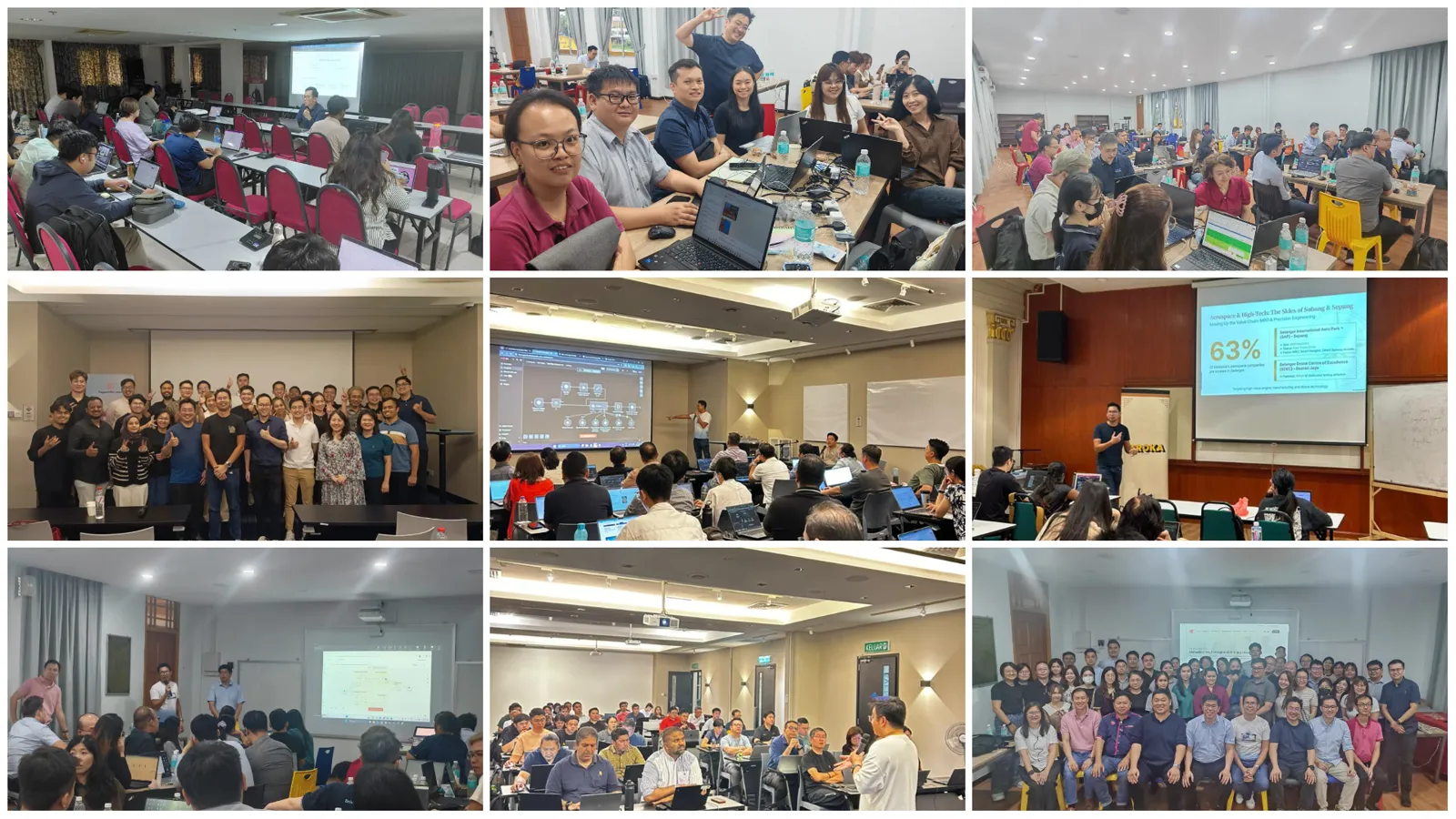
Banking, telco, retail, healthcare, energy & government-linked companies — teams across Malaysia upskill with AITraining2U.
Claude vs the field
Strong reasoning, browser control & data work — ideal for research, scoring & building live dashboards.
Broad all-round use, image & voice, the largest ecosystem.
Google Workspace, very large context & search grounding.
Living inside Microsoft 365 — Excel, Word, Outlook, Teams.
Research the web, reason over data, and ship a working dashboard in one thread. The plays you learn here transfer to whatever model wins next — but right now, Claude does the full loop best.
Stop "Googling". Start delegating growth work.
Most growth work is the same loop: research → score → decide → ship. A chatbot answers one question at a time. Claude runs the whole loop — it reaches the live web, reasons over your data, and produces an artifact you can act on.
Your job shifts from doing every step yourself to writing the brief and reviewing the output — like managing a sharp growth analyst who never sleeps.
Four growth plays, one operator
Every play ships with a set of copy-ready prompts — tap Copy, paste into Claude, edit the bracketed bits, run.
Competitor
Research
Know the field cold — what they sell, how they price, how they win, and where the gap is. Claude reads the live web so you don't open 40 tabs.
From 40 open tabs to one battlecard
Competitor research prompt set
Using Claude for Chrome, research these competitors: [Rival A url], [Rival B url], [Rival C url]. For EACH, visit the homepage, pricing & about pages and extract: - One-line positioning & target ICP - Core offer & top 3 features - Pricing tiers (price, what's included) - Proof: logos, case studies, reviews - Tone & key messaging hooks Output a clean comparison table, one row per competitor. Cite the URL for each fact. Flag anything you couldn't verify.
Here is our product: [1-paragraph description + pricing]. Using the competitor table you just built: 1. Plot a positioning matrix on two axes I care about: [axis 1] vs [axis 2]. 2. Identify 3 "white space" gaps no rival owns (segment, price point, or message). 3. For each gap, rate how defensible it is for us (High/Med/Low) and why. 4. Recommend ONE positioning angle we should test next quarter. Build this as an interactive artifact I can share with the team.
Create a sales battlecard for beating [Rival A] specifically. Include: - Their strengths (be honest) & weaknesses - 5 common objections a prospect raises comparing us to them - For each: a crisp "when they say X, we say Y" rebuttal grounded in fact - 3 discovery questions that expose where we win - A one-line "trap" question to ask the prospect Keep it to one page, scannable, no fluff. Tag any claim that needs proof from our team.
Tip: save these three as a Project so every new competitor reuses the same standing brief.
Reverse-engineer competitor ads
Every Meta advertiser's live ads are public in the Meta Ad Library — free competitive intel. Point Claude at it (e.g. "ai agents" · Malaysia · Active) and it reads the hooks, offers and the ads that have run longest — the likely winners.
Open the Meta Ad Library for our market: facebook.com/ads/library → search "[keyword]", Country = Malaysia, Status = Active. Using Claude for Chrome, for the top advertiser [competitor] capture each active ad: - Hook (first line / thumbnail text) - Format (image / video / carousel) - Core offer & CTA button - Landing page it sends to - How long it's run (start date) Output one row per ad, tagged by advertiser. Scroll to capture them all; give me the count.
From the ads you collected, find the patterns: 1. Group ads by ANGLE (pain, proof, price, speed, authority, FOMO…). 2. Flag the likely WINNERS — ads running the longest or duplicated many times. 3. Which hook styles & offers repeat across competitors? 4. What's the common landing-page promise? Summarise the 5 angles working in our market right now, ranked, with one example each.
Turn this into action: 1. Build a swipe file of the 10 best ad ideas (hook + why it works). 2. Spot the GAP — an angle nobody is running. 3. Draft 3 differentiated ad concepts for us: hook, primary text, CTA, visual direction. 4. Give me a test plan: which to run first, budget split, and the metric to watch. Keep our brand voice. Flag any claim we must substantiate before publishing.
Heuristic: an ad that's been running for weeks is paying for itself — longevity is the public signal of a winner.
Audit, find the keywords, fill the gaps
Claude crawls a URL and flags titles, meta, headings, internal links, schema, speed signals & thin content — ranked by impact.
From a seed topic, generate keyword clusters grouped by search intent — informational, commercial, transactional — with priority calls.
Compare your coverage to competitors, then turn each gap into a ready-to-write content brief: H2s, FAQs, internal links, word count.
SEO audit & keyword prompt set
Using Claude for Chrome, audit this page: [URL]. Target keyword: [keyword]. Check and score (0-5) each of: - Title tag & meta description - H1 / heading structure & keyword use - Content depth vs search intent - Internal & external linking - Image alt text & file names - Schema / structured data present? - Obvious speed & mobile red flags Output a table: Issue | Severity | Fix | Effort. Sort by impact. End with the top 5 fixes to do first and why.
Seed topic: [topic]. Market: [country]. Audience: [who]. Generate a keyword map: 1. 40-60 keyword ideas (head + long-tail). 2. Group into 6-10 clusters by theme. 3. Tag each cluster's dominant intent: informational / commercial / transactional. 4. Estimate relative difficulty & priority (High/Med/Low) with one-line reasoning. 5. Suggest ONE pillar page + supporting posts per high-priority cluster. Present as a table grouped by cluster.
Compare our site [our URL] to competitor [competitor URL] for the topic [topic]. 1. List content they rank for that we don't cover (the gaps). 2. Pick the 3 highest-value gaps for us. 3. For each, write a content brief: - Working title & target keyword - Search intent & angle - Suggested H2/H3 outline - 5 "People also ask" FAQs - Internal links to add - Target word count & meta description Make it ready to hand to a writer.
Tip: schedule prompt 1 as a weekly routine on your top 10 pages to catch SEO drift automatically.
Spend your time on the leads that close
Lead scoring prompt set
We sell [product] to [market]. Here are our 10 best customers and why we love them: [paste list / notes]. 1. Infer our Ideal Customer Profile: firmographics, role, behaviour & intent signals that predict a good fit. 2. Design a transparent 0-100 scoring model: list each factor, its weight, and how to score it. Keep it explainable. 3. Define tier cut-offs (A/B/C) and what each tier should trigger. Show the model as a table I can reuse.
Here is my lead list (CSV attached / pasted below): [data]. Using the scoring model we built: 1. Score every lead 0-100 and assign a tier. 2. Add a column explaining the top 2 reasons for each score. 3. Sort highest to lowest. 4. Flag any lead missing data that would change the score if filled in. 5. Give me the headline: how many A / B / C, and total A-tier pipeline value. Output as a clean table I can paste to Sheets.
For my A and B tier leads, recommend a next-best-action for each. For every lead give me: - The action (call / demo / nurture / wait / disqualify) and timing - A one-line reason tied to its score - A 2-sentence personalised opening message referencing their likely pain point Then build it all as an interactive artifact: a sortable board with tier, score, action and the draft message per lead.
Tip: keep the model in a Project so every new list is scored the same way — and refine the weights as deals close.
Size the market — then make it a dashboard
TAM / SAM / SOM built bottom-up and top-down, with every assumption stated so you can defend the number.
Paste reviews, survey answers or call notes — Claude clusters themes, pulls quotes, and ranks pains by frequency & intensity.
Turn the findings into an interactive artifact — charts, filters & KPIs — that you can share without a BI tool.
Market research prompt set
Size the market for [product] in [country/ region]. Buyer: [who]. Price point: [price]. 1. Use the web to find relevant figures (population, businesses, spend) — cite each source. 2. Estimate TAM, SAM and SOM both top-down AND bottom-up. 3. State every assumption explicitly and show the math. 4. Give a realistic 3-year SOM scenario (low / base / high). Flag where the two methods disagree and which number you'd trust for a board deck.
Here is raw customer feedback (reviews / survey answers / call notes): [paste data]. 1. Cluster it into the main themes. 2. For each theme: % of mentions, intensity (mild/strong), and a representative quote. 3. Rank pains by frequency x intensity. 4. Separate "table stakes" from "delighters". 5. Recommend the top 3 things to fix or build next, with the evidence behind each. Be honest about small sample sizes.
Turn the market sizing + voice-of-customer findings into an interactive dashboard artifact. Include: - KPI strip: TAM/SAM/SOM & top pain - A bar chart of themes by frequency - A TAM/SAM/SOM funnel visual - A filter to switch low/base/high scenario - A short "so what" insight box Use a clean, modern style. Brand accent #D97757 on a cream background. Make it shareable and self-explanatory.
Tip: combine all four plays into one Project — your standing "Growth Cockpit" that researches, scores and visualises on demand.
Your weekly growth engine
The four plays aren't separate chores — they're one compounding loop. Wire them into a single Project with standing instructions, then schedule the recurring parts as routines.
Research feeds scoring. Scoring sharpens targeting. Targeting informs content. Content is measured by the market. Claude runs the lap; you steer.
Hand the whole loop to Cowork
The weekly engine from the last slide — run for you. In Claude Cowork you write one brief and Claude works autonomously in the background: it spins up sub-agents, uses your connectors, and returns a finished deliverable to review. Three real briefs:
Cowork brief — run my weekly growth digest. Every Monday 8am, autonomously: 1. Competitor watch: re-check [Rival A/B/C] sites & pricing; flag changes vs last week. 2. SEO drift: audit my top 10 pages; list new issues + 1 content brief. 3. Lead scoring: score new leads in [sheet/CRM] with our model; surface the A-tier. 4. Market pulse: this week's signals for [market], 3 bullets. Compile a one-page digest with a "do this first" section. Draft — don't send — a Slack summary for #growth. Tell me what you couldn't access.
Cowork brief — full competitor sweep. For EACH competitor — [Rival A], [Rival B], [Rival C], [Rival D] — run a separate research pass and capture: - Teardown (offer, pricing, ICP, proof) - Changes in the last 90 days - Their strongest & weakest message Then merge everything into: 1. One comparison matrix 2. A battlecard per competitor 3. A single "where our white space is" view Work through them in parallel and hand me the finished pack as an artifact. Cite every source.
Cowork brief — entry pack for [segment / country]. Autonomously produce a go-to-market starter: 1. Market sizing: TAM/SAM/SOM with sources & assumptions. 2. Competitor map: who's there + the gaps. 3. ICP + a lead-scoring model for this segment. 4. Keyword + content plan for the first 90 days. 5. A 1-page interactive dashboard tying it together. Save each as a file in this project. Flag the 3 biggest risks and what to validate before we invest.
Cowork pauses before anything irreversible — it drafts the emails & updates; you approve the send.
What you can now run with Claude
The shift: from doing the busywork → to writing the brief and reviewing the result.
Now go hack
your growth.
Pick the one play that moves your number this quarter — research, SEO, scoring or sizing — and make it your first Claude project. Start small, schedule it, then scale into the full engine.
Practical. Proven. Purposeful. — AITraining2U PLT
Our courses at AITraining2U.com
All courses are HRDC-claimable — available as enterprise & public workshops. AITraining2U.com